Showing posts with label Customer Service Teams. Show all posts

Sunday, 17 August 2014

Google Responds To Mass Negative SEO Extortion Emails

google-police-fade-ss-1920

There are widespread reports within the industry of negative SEO extortion emails being sent to website owners, webmasters, SEOs and others. The emails are claiming that an evil SEO will ruin the site’s ranking in Google and other search engines if they do not come up and wire $1,500 to the evil SEO. Both Dan Petrovic, Steve Webb and George Zlatin, amongst others, posted copies of the emails.
The email reads:
Subject: I Want To Buy. Please Guide Me.
Hello,
Read this email very carefully.
This is an extortion email.
We will do NEGATIVE SEO to your website by giving it 20,000 XRumer forum profile backlinks (permanent & mostly dofollow) pointing directly to your website and hence your website will get penalised & knocked off the Google’s Search Engine Result Pages (SERP) forever, if you do not pay us $1,500.00 (payable by Western Union).
This is no false claim or a hoax, download the following Notepad file containing 20,000 XRumer forum profile backlinks pointing to http://www.negativeseo.cn.pn/ (this is our website and go and see on this website, you will find our email address issmt1@yahoo.com from which this email right now is being sent to you) :
http://www.mediafire.com/download/eizjwnpq2rsrncu/20000-XRumer-Forum-Profile-Backlinks-Dofollow.txt
Just reply to this email to let us know if you will pay just $1,500.00 or not for us to refrain or not from ruining your precious website & business permanently. Also if you ignore this email and do not reply to this email within the next 24-48 hours, then we will go ahead and build 20,000 XRumer forum profile backlinks pointing directly to your website.
We are awaiting your wise decision.
RS
Google’s stance on negative SEO has changed throughout the years, previously stating there is “almost nothing a competitor can do to harm your ranking or have your site removed from our index,” to now saying “Google works hard to prevent other webmasters from being able to harm your ranking or have your site removed from our index.”

We forwarded these negative SEO extortion emails to Google and Google responded that they have “investigated” the claims. They added that it is “unclear how credible this threat really is.” Google told us their “algorithms are designed to prevent these kinds of activities from causing problems for webmasters.”

But if you are concerned about specific links, “you can also choose to use the disavow tool,” Google told us. In addition, Google is recommending you “report extortion to law enforcement,” although that doesn’t do much good if the email comes from countries law enforcement has no control over. But if it is received on Gmail, Google asks you to report it at at https://support.google.com/mail/contact/abuse.

Truth is, negative SEO extortion is not new. I reported about cases of this back in January but this specific email is going out to many, many webmasters and site owners.


If you are concerned, yes, use the disavow tool. But make sure to keep an eye on your most recent links in Google Webmaster Tools and then disavow any new links that come up that concern you. If you do that, these guys will have a hard time hurting your site.


Tuesday, 12 August 2014

6 Ways to Use Social Media for Actionable Insight

Social media represents the largest source of consumer data in the history of the world.


Social media 'listening' is a no-brainer.

People like you and me willingly go online to share their passions, concerns and opinions about almost everything. And the companies that have embraced social listening are seeing a huge 'return' in the insights gleaned from this public source of consumer data.

The biggest challenge for teams, quite frankly, is selecting the right tool(s) when the options seem endless. (Has anyone else seen this chart? And that was two years ago!) Most of these solutions allow you to monitor, measure, publish and engage in some way across or multiple social media channels. Don't get me wrong, numbers and charts and graphs really do look great at first. But, once the initial "wow" factor wears off, those quantitative measurements serve more as 'health checks' for content and engagement programs than a metric to share with the C-Suite to demonstrate value to the bottom line. 

Hope is not lost. Our industry is getting there, but we must first move beyond social media monitoring.

What's next?

Every social media marketer should google "text analytics" and "data scientist." Since I'm not an expert at either, I can't connect words and phrases to measure their meaning (which is what text analytics is if I way over simplify it) or identify patterns in data and develop advanced algorithms (which is a fraction of what a data scientist can do). But I do know that I want those people on my team so I can gain a competitive advantage. 

Social Media Intelligence turns consumer data into action.

With the right research partner, this level of insight is possible. 
Here are six ways to use social media for actionable insights:
  1. Discover unknown unknowns. Sometimes you just don’t know what you don’t know, which means you may not ask your consumers the right question to reveal an 'aha' moment. Enlist a trained researcher to scan the wealth of conversations taking place across social media channels to reveal insights that can jumpstart your next campaign. Don't limit your channels to just Facebook and Twitter either. Look at blogs, forums and public message boards. The short-form of Facebook and Twitter are great for finding "whats," where the latter provide context to know the "whys."
     
  2. Richer Audience Segmentation. Traditional demographics like age, gender and location are becoming a thing of marketing past. The ability to drill down into attitudes and specific preferences to personalize each marketing engagement is becoming status quo. Social media intelligence can help you better understand your audience and what makes them tick by using text analytics to 'decode' their social conversations to reveal unmet needs and secret desires.
     
  3. Product Development. The best products do one thing: fulfill an unmet need. This could be in the product itself or the way it’s marketed and communicated to its target audience. Use social media to survey the buying landscape, scope out the competition and ensure your product meets the need(s) your audience is telling you they need.
     
  4. Campaign Effectiveness. You know the saying, “quality over quantity?” Well, it has never been truer than in the current age of technology where everything is shared, retweeted, liked, reposted, hash tagged and, if you’re really lucky, even spoofed! Chasing arbitrary metrics can be exhausting and provides little value over time, which is why many companies are moving to social media intelligence for more intrinsic measures – like reputation lift – to inform strategy for their next campaign.
     
  5. Event/Conference Improvement. If attendees at your last event were carrying smartphones, you best believe they were taking “selfies” and tweeting about their experiences. You can track those slices of feedback and analyze them to discover a number of things, like which speaker(s) hit the mark or which issues caused pain points (e.g., long registration lines or low-quality Wi-Fi access). Knowing what went right and what fell short helps inform the event-planning process the next time around.
     
  6. PR Effectiveness. Protecting brand reputation is a PR team’s primary objective. What if you could get out in front of a potential crisis before it crippled your ability to respond, or you could monitor public perception during a challenging time for your company or brand. Use the wealth of information shared across social channels to drill deeper into what specific messages are working or what topics do more harm than good. This level of insight can help your team justify its strategy in a number of ways.
Before social media, it wasn't as easy to extract public opinion or glean consumer perception in almost real-time. Now, with advanced research and Social Media Intelligence, we can glean real insights to inform business strategy in so many ways.

What have you done to move your company past monitoring? I'd love to hear how you've been successful.


Tuesday, 5 August 2014

How to Create a Site Structure That Will Enhance SEO

The better your site structure, the better your chance of higher ranking in the search engines. Every website has some “structure.” It might be a rigorous and streamlined structure, or it may be a disorganized jumble of pages. If you are intentional and careful with your site structure, you will create a site that achieves search excellence.

In this article, I share some of the best advice on creating a powerful site structure. The tips below will help you create a site that appeals to users, gets crawled and indexed by spiders, and delivers the best SERP listings and rankings possible.

Why Structure Matters

As I’ve worked with hundreds of clients over the years, I’ve been surprised at how often site structure is overlooked. On the one hand, it’s one of the most crucial aspects of a site’s SEO performance, but on the other hand, few webmasters and owners understand what it means to have a site structure that enhances SEO.

I’m going to share a few of the reasons why site structure is so crucial, and then get into the how-to of developing your own SEO-friendly site structure.

A good site structure means a great user experience.

When you take away the colors, the fonts, the kerning, the graphics, the images, and the white space, good site design is really about a great structure.

The human mind craves cognitive equilibrium — being able to put pieces logically together, finding things where they’re expected, and locating what they are seeking. Thus, a strong and logical site structure is cognitively satisfying to users.

As you know, the more appealing your site to users, the more appealing it is to search engines, too. Google’s algorithm uses information from searchers to rank your site. If your site has poor CTRs and low dwell time, it will not perform well in the SERPs. By contrast, when a user finds a site that they like — i.e. a site with great structure — they don’t bounce and they stay longer. An accurate site structure can reduce bounce rate and improve dwell time, both of which will lead to improved rankings.

A good site structure provides your site with sitelinks.

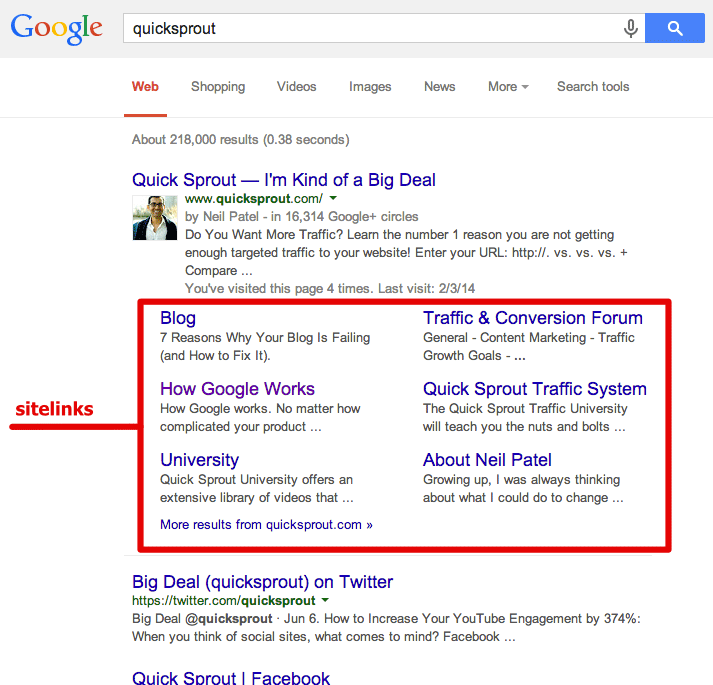
Sitelinks are a listing format in the SERPs that show your site’s main page along with several internal links indented below. You’ve seen them before.

quicksprout in serps

Sitelinks are a huge SEO advantage. They increase the navigability of your site, point users to the most relevant information, increase your brand’s reputation, improve user trust, help you dominate SERPs, increase clickthrough rate, and shorten the conversion funnel. Basically, sitelinks are awesome.

But how do you get sitelinks? You don’t simply go to Google Webmaster Tools and fill in a few fields on a form. You can’t issue a sitelink request. Instead, Google’s algorithm automatically awards websites with sitelinks. And they do so based on great site structure.

If you have a poor site structure, it’s very likely that your site will never receive site links. The absence of sitelinks could be costing your site more targeted traffic, higher CTR, and increased conversions.

A good structure means better crawling.

Web crawlers like Googlebot crawl a website’s structure. Their goal is to index the content in order to return it in search results. The better your site structure, the easier the crawlers can access and index the content.

Crawler’s don’t automatically discover everything on your website. Google even admits, “[there are] pages on your site we might not…discover,” or “URLs that may not be discoverable by Google’s normal crawling process.” (That’s one of the reasons why Sitemaps are necessary.) However, crawlers will have a far easier time accessing, crawling, indexing, and returning the pages of a site with strong structure.

A good site structure is at the very core of good SEO — optimizing for the crawlers.

To sum up, your site’s organization paves the way for SEO success. In fact, it could be argued, that without a good site structure, you will never have SEO success. Strong site structure gives your site an unbreakable SEO foundation that will provide you with vast amounts of organic search.

Six Steps to Creating Site Structure

Now, I’ll tell you how to create this kind of site structure.

1. Plan out a hierarchy before you develop your website.

If you’re starting a website from scratch, you’re in a great position to plan out site structure for the best SEO possible. Even before you start creating pages in a CMS, plan out your structure. You can do it on a whiteboard, a spreadsheet program (Excel, Google Drive Spreadsheets), most word processors, or something like Visio or OmniGraffle.

A “hierarchy” is nothing more than a way to organize your information — something that is simple and makes sense. Your hierarchy will also become your navigation and your URL structure, so everything important begins here.
Generally, a site hierarchy looks like this:
website breakdown
There are a few features of hierarchy that you should keep in mind.
  • Make your hierarchy logical. Don’t overthink or overcomplicate this process. You want simplicity, both for your own sake and for the ease of crawlers and users. Each main category should be unique and distinct. Each subcategory should somehow relate to the main category under which it is located.
  • Keep the number of main categories between two and seven. Unless you’re Amazon.com, you don’t want to have too many main categories. There should be only a few main things. If you have more than seven, you may want to rethink the organization, and pare it down a bit.
  • Try to balance the amount of subcategories within each category. Basically, try to keep it approximately even. If one main category has fourteen subcategories, while another main category has only three subcategories, this could become a little unbalanced.
A site hierarchy is the beginning point for a great site structure.

2. Create a URL structure that follows your navigation hierarchy.

The second main element in developing strong site structure is your URL structure. If you’ve logically thought through your hierarchy, this shouldn’t be too difficult. Your URL structure follows your hierarchy.
So, let’s say your hierarchy looks like this:
example site structure
The URL structure for the Chinatown location would look like this:

Your URL structure will be organized according to your site hierarchy. This means, obviously, that your URLs will have real words (not symbols) and appropriate keyword coverage.

3. Create your site navigation in HTML or CSS.

When you create your navigation, keep the coding simple. HTML and CSS are your safest approach. Coding in JavaScript, Flash, and Ajax will limit the crawler’s ability to cover your site’s well-thought out navigation and hierarchy.

4. Use a shallow depth navigation structure.

Your navigation structure will obviously follow your site hierarchy. Make sure that pages, especially important ones, aren’t buried too deep within the site. Shallow sites work better, both from a usability and crawler perspective, as noted in this Search Engine Journal article:

A shallow website (that is, one that requires three or fewer clicks to reach every page) is far more preferable than a deep website (which requires lengthy strings of clicks to see every page on your site).

5. Create a header that lists your main navigation pages.

Your top header should list out your main pages. That’s it. My website, Neilpatel.com uses a very simple top navigational header with three subcategories. This accomplishes everything I need.
neil patel site structure
Adding any other menu elements apart from your main categories can become distracting and unnecessary. If you’ve designed a parallax site, be sure to provide a persistent header menu that displays through each scrolling phase.

While dropdown menus using CSS effects or disappearing menus may provide a unique or intriguing user experience, they do not enhance SEO. I advise against them. I also advise against using an image-based navigational structure. Text links with appropriate anchors provide the strongest form of SEO.

If you have a footer with menu links, be sure to duplicate the main links of your top navigational menu in your footer navigation menu. Changing the order of links or adding additional category listing will complicate the user experience.

6. Develop a comprehensive internal linking structure.

Internal linking puts meat on the bones of a logical site hierarchy. Moz’s article on internal links lists three reasons why they are important:
  • They allow users to navigate a website.
  • They help establish information hierarchy for the given website.
  • They help spread link juice (ranking power) around websites.
Each of these is directly tied to creating a tight-knit and well-integrated site structure.

There’s no need to get complicated with internal linking. The basic idea is that every page on your website should have some link to and some link from another page on the website. Your navigation should accomplish internal linking to the main categories and subcategory pages, but you should also make sure that leaf-level pages have internal linking as well.

Internal linking tells the search engines what pages are important, and how to get there. The more internal linking you have across all pages, the better.


Tuesday, 8 July 2014

Mobile Now Exceeds PC: The Biggest Shift Since the Internet Began

If you’re still struggling to leverage the website to support goals, you have some catching up to do, as the landscape has recently experienced a tectonic shift.

Mobile Exceeds PC Internet Usage for First Time in History

In early 2014, the landscape in which businesses operate changed forever when Internet usage on mobile devices exceeded PC usage.

Time Spent on Internet Desktop vs Mobile

It has taken considerable time for businesses and brands to embrace the potential of the Internet. Today, most recognize the Internet as a vital foundation for everything from operations to marketing and sales to logistics, CRM, and customer service.

Still, many businesses and brands struggle to truly leverage the digital landscape to meet the expectations of their customers. Many more will struggle with the migration of audiences (customers) to mobile.

The time has come to seriously consider integration of mobile-friendly versions of all mission-critical assets: applications, data, the website, communications, demos, sales materials, customer service, etc.

What Are Consumers Doing on Mobile?

How do consumers use mobile devices to access the Web? According to Online Publishers Association/Frank N. Magid Associates:
  • 99.5 percent access content/information
  • 63.1 access the Internet
  • 62.1 percent check email
  • 49.2 percent listen to music
  • 46 percent play games
  • 41.7 percent download and use apps
  • 15 percent make purchases
  • 15 percent read a book

Shift to Mobile Impacts B2B Significantly

If you imagine that the mobile usage is merely a reflection of consumers logging onto social media, checking email or conducting search, or shopping, think again.

Executives lead the way in mobile adoption, validating the theory that digital assets for a business or brand must serve target audiences 24/7, and not just during business hours.

What Time of Day Do B2B Professionals Conduct Mobile Research

Meeting your customers wherever they work is no longer a luxury – it is a necessity. If you wish to convert interaction to action you must compel the decision-maker.

B2B Decision-Makers Rely on Mobile Devices

Mobile is preferred over the PC for executives conducting research during and after office hours, according to the IDG Global Mobile Survey 2014.
  • 92 percent of executives own a smartphone used for business.
  • 77 percent of executives use their smartphone to research a product or service for their business.
  • 93 percent of executives will purchase that product via the Internet using a laptop or desktop.
  • 86 percent use their tablet and 72 percent of executives use their smartphone to conduct research for products or services for their business.
Business Product Research on Mobile

Executives rely upon mobile devices (tablets and smartphones) to conduct business research more frequently in the evenings than any other time of day.

Mobile as a Competitive Advantage

Whether your day-to-day focus is business management, marketing, sales, SEO, social media, advertising, software development, or customer relationship management, the mobile device has increasingly become the preferred tool for work and communication. How quickly and effectively an organization plans, develops, and adapts to deliver quality mobile experiences will likely become a competitive advantage.


Some organizations may continue to view mobile as an “add-on” or supplementary effort when planning for digital interaction with customers. However, those who embrace the shift in behavior and deliver what their customers want and need to make a purchase decision will likely be the ultimate winners.

Full view on this post visit here


Thursday, 3 July 2014

The 8 Best Industries for Starting a Business (In Detail)


Digital detective. Health care disrupter. Purveyor of all things organic. These are just some of the most promising ground-floor opportunities in 2014.

Some entrepreneurs are drawn to the New New Thing; they hunger for a first-mover advantage. To them we say, best of luck. Others want to enter a promising industry early on, but with some evidence that the industry actually exists and has room for new players. To them we say, welcome.
Our annual look at the best industries for starting a business is based on a range of research, interviews, and scouting reports. We’ve identified a cross section of businesses that call for a variety of skills, from technological expertise to retailing savvy to, above all, the ability to innovate. Think of these industries not as New New but as Hot Hot. They are up and running but still very much in their early days. If you have the right skills and focus, you have plenty of opportunity not only to jump on the bandwagon but to call the tune.

Jeff Bezos triggered a near-meltdown in the Twittersphere when he suggested that Amazon might deliver products via drones. Closer to earth, Amazon did spend $775 million in 2012 to buy Kiva Systems, which manufactures robotic automated guided vehicles, or AGVs. These devices automate many earthbound warehousing and logistical functions, such as picking products to fill a specific order and prepping them for loading onto good ol’ trucks. Though they may lack the sci-fi sexiness of drones, AGVs such as forklifts, loaders, and towing vehicles are increasingly in demand, as companies pursue a Warehouse 2.0 strategy, using any and all technologies available to cut costs and speed up fulfillment. 

Why it’s Hot: AGVs are used in numerous industries, including pharmaceuticals, chemicals, food, automotive, warehousing, and other businesses that require the movement of materials. 

The Downside: Startup costs are high. We’re talking about a sophisticated manufacturing operation here, often reliant on raw materials including steel, which has been getting more expensive. The technology is also evolving fast, which means keeping up with the latest trends in laser targeting, gyroscopic, optical, and magnetic navigation systems. 

Skills Needed: Experience in robotics and computer systems. If you lack the capital or partnerships to jump into manufacturing, you could focus on software or subcomponents. 

Competition: There is no dominant player, but the top four companies account for half the industry revenue. Savant Automation, Dematic Group, and Bastian Solutions are among the companies that merit a look as you research this market. 


The housing industry is returning to a state of market equilibrium as supply and demand balance and prices rebound. One particularly robust sector is green construction, which emphasizes designs and materials that maximize energy-efficiency and environmental sustainability. New building codes and tax credits are helping the sector take off. 

The Outlook: Demand is booming. Within the next two years, more than half of all commercial and institutional construction will have a decided tint of green, according to the U.S. Green Building Council. 

Uncle Sam Wants You: At least half of all green construction projects will be funded by U.S. government agencies, as new schools, government offices, and other projects must meet more stringent standards. 

Industry Buzzword: LEED, short for the Leadership in Energy and Environmental Design program. You’ll want to bone up on certification requirements. 

Barriers to Entry: Skilled workers are scarce, and an established reputation really helps. 

Competition Traditional builders have jumped into green building, and the number of new companies is growing by 15 percent annually. 


Talk about the intersection of two hot trends: The world is going mobile, and everything regarding health care is up for a rethink. Put them together, and you have “mHealth,” as in “mobile health.” An aging population, increasing chronic illness, accelerating health costs, new regulatory reforms, and increased consumer demand for health information and self-care will have doctors, patients, and everyone in between eager to see as much health information as possible made available on every kind of mobile device. 

Vital Signs: The global mHealth market is poised to surpass $10 billion by 2018. 

Bone Up: Though it’s not exactly a beach read, the fine print of the Affordable Care Act can point you to opportunities in specific sectors. 

Promising Niche: Remote patient monitoring. mHealth apps promise to cut the time and money spent on visits to the doctor’s office by remotely tracking measures related to many chronic illnesses. 

Technical Challenge: Security. As more patient data is captured, companies risk violating rules under the Health Insurance Portability and Accountability Act, or HIPAA. 

Competition: Companies specializing in everything from medical devices to exercise gear are jumping in. HealthTap, Patient Conversation Media, and Informatics Group offer some useful lessons on where things are heading. 


As consumers awaken to the presumed health benefits of foods such as kale and quinoa, retail stores specializing in organic, gluten-free, and healthful foods are sprouting up everywhere. There has also been a parallel boom in the businesses creating the foods these stores sell. Since 2003, an average of 4,300 specialty-food products have been launched. Though we may not yet be at the “Salad: It’s What’s for Dinner” stage, we’re eating a wider variety of healthful foods than ever. 

Big Appetites: Total specialty-food sales in 2012 topped $85 billion, according to the Specialty Food Association. The fastest-growing segments are energy bars and gels and shelf-stable beverages. Interested in something more indulgent? Artisanal cheeses are huge. 

Promising Niches: Ninety-five percent of specialty-food stores carry all-natural products, and 88 percent are riding the locavore train, with “local” foods defined as those produced within 200 miles of where they are sold. 

Startup Need: For retailers, a store. The size of the average specialty-food store is slightly more than 5,000 square feet, with room for some 1,400 products. Location is key, because you’ll need to be close to customers willing to pay for premium products. For would-be food makers, you may only need a good recipe, quality ingredients, a commercial kitchen, and a van. To start, anyway. 

Competition: National chains such as Whole Foods, regional players like Mom’s Organic Market, and expanding organic offerings from traditional grocers and big-box retailers, including Walmart. 


One of the fastest-growing segments of online retailing focuses on the needs of consumers who don’t use computers (or at least, not well): babies. Products from diapers, clothing, and shoes to feeding aids, strollers, and furniture defied the recession and remained in high demand. The demand is still intense, and increasingly it is being satisfied online. Baby apparel alone will ring up $6 billion in e-tail sales this year. 

Growth Spurt: Experts say demand will increase over the next five years, owing to demographic factors (primarily, an increased birthrate) and a rise in disposable income that will prompt busy parents to shop from their couches whenever they can grab a few minutes of peace. 

Promising Niches: More than 40 percent of all revenue in this sector comes from the sale of diapers, so think outside the training pants. Organic skin care and branded baby clothing, however, are the kinds of things that can help you carve out a space. 

Competition: Getting noticed could be tough: By 2018, it’s predicted, there will be more than 6,000 baby-product e-tailers. Look at i play, 4Moms, Babyhaven, and Happy Family Brands for inspiration. 


It may be a small world, but it certainly has a lot of languages. More than 6,700, to be semi-exact. As businesses become more global, demand for people (or companies) who can bridge the language divide is growing. An increase in foreign tourists visiting the U.S. is also a factor, as is the need to communicate with Hispanic and other non-native-English speakers now living in the U.S. 

Talking Points: A big opportunity can be found in website localization. As U.S. companies look to expand into markets such as China, Brazil, Russia, Eastern Europe, and the Middle East, there will be increased demand for individuals and companies that can translate English-based sites into local languages. One recent study found that just 20 percent of the top U.S. retailing sites have information translated into a language other than English. 

Promising Specialties: U.S. health care companies, which are rapidly expanding into South America, Canada, Europe, and the Asian-Pacific market. There is also high demand for translating official immigration documents, including birth and marriage certificates, and diplomas. 

Big Threat: Automation. The use of artificial intelligence, as well as voice and optical character recognition, is expected to increase drastically in the next five years. And, of course, there are apps for this. 

Competition: There are about 50,000 translation businesses out there, but 95 percent of them are individual operators, so the opportunity to pursue this field as a true business is grande. 


The proliferation of smartphones, tablets, and PDAs has brought with it the very real possibility that people will have an increasing need to retrieve precious data, either because they’ve lost it (think a CFO’s laptop falling down the stairs) or because someone is trying to hide it (think computer crime). As a result, the demand for digital forensic services is booming. 

Promising Niches: The crime-fighting side is where the action is. Companies that can assist investigations into phishing schemes, bank fraud, and child-exploitation cases will be in high demand. The ability to recover data from compromised machines and networks is also promising; it’s expected to account for half of all sector revenue over the next few years. 

Barriers to Entry: You’ll need the technical chops to retrieve data from hard drives, networks, and the cloud, which has greatly complicated the tracking of data. You’ll also need to know about regulatory and compliance issues, and you may need certain security clearances if you pursue government work. 

Competition: There are companies that specialize in this area, and traditional IT-services companies and large consulting organizations are also touting their forensic capabilities. Check out AccessData Group, D4 eDiscovery, and CaseDriven Technologies. 


As tablets become the de facto portable business device, companies want to help employees be more productive by making sure simple (but critical) functions are just an icon-press away. In this world, you are really limited only by your imagination. And coding ability. 

Skill Set: The hot programming languages to know for building business apps are JavaScript and HTML5. From a software-design standpoint, think about building simple mobile apps that can be integrated to create larger applications. 

Promising Niche: Corporate social software. Apps that help your employees share what (and who) they know with one another, so that one person’s connection becomes everyone’s connection. That can help with a number of things, from hiring the best people to landing new clients. 

Who’s Buying?: The greatest demand is coming from financial services, manufacturing, the federal government, retail, communications, and high tech. Big companies tend to prefer big vendors, but if you have a clever app you can get their attention. Small and medium-size companies are more amenable to small businesses and even sole proprietors, but they don’t have deep pockets. 
Competition: Have you visited an app store lately? It’s a crowded field, so in addition to searching out companies whose apps might be close (but not too close) to yours, also invest in social-media expertise and create a great website. Both are table stakes for getting noticed and can also highlight your tech savviness and industry knowledge. 


Thursday, 19 June 2014

Social Customer Service for Marketeers


Customer service IS marketing. I’ll say it again… customer service IS marketing. Because the way you treat your customers is promoted on social media, ratings and reviews every single day, your customer service is no longer an indicator of customer satisfaction, retention or value. Your customers are now a key arm to all of your marketing efforts because they share readily online.
While Marketing Teams aim to increase brand awareness and lead generation through pushing out information and generating positive engagement, Customer Service Teams aim to improve customer satisfaction and increase customer retention by listening, and responding to customer needs. How the two meet is often seen as a challenge among many organizations. Source: Sentiment
While 60% of companies believe social media is just a marketing channel, they’re ignoring the amplification of their brand through consumer advocates or detractors. All it takes to derail months or years of hard work building trust, authority, and an emotional connection with your audience is mishandling a single event that’s published and promoted on social media.