Showing posts with label online marketing. Show all posts

Thursday, 3 July 2014

5 Web Marketing Basics to Give Your Business a Boost


Now's the time to make a serious investment in online marketing. Here are five places to start.

When your business is in the red, there’s often more than one place to point the finger. One place you may not consider, however, is your marketing mix. (You are marketing, right? If not, this is undoubtedly the root of your problem.)
If it's not in the mix yet, now's the time to make a serious investment in Internet marketing. It’s one of the most effective ways to spread the word about your business, products, or services due to its unmatched reach and efficiency.
Here are five Internet marketing tactics you need to master:
1. A well-designed website. Design matters, especially when it comes to your website. This is because your website is the most powerful marketing tool for your business. In fact, poor or overdone Web design can get in the way of properly reaching your target audience and meeting business goals, resulting in an almost immediate loss in leads and revenue.
When your business is struggling, evaluating and improving your current Web design should be on the top of your to-do list. Do you have a clear call to action? What about effective, up-to-date content? Consider hiring a trusted agency or individual to handle your Web development needs.
2. Smart(er) SEO. Getting your brand to the top of search engine results is something every business wants. Still, optimizing your website and online content isn’t always top priority when it comes to marketing. Too many business owners think it requires a complex knowledge of programming. It really comes down to finding the right tools, understanding keywords, revising website and blog structure, and regularly creating content.
In light of the recent Google algorithm update Penguin 2.0, you need to be more aware of your SEO habits due to an increased focus on link spam. With this update, Google is showing more interest in helping websites become authorities in their niche--and ranking them higher when they are. Boost awareness for your company through the use of Author Rank, social sharing, and Google+ activity.
3. Noteworthy email marketing efforts. If you’re looking to reach your customers and stick to a tight budget, email marketing might do the trick. It’s your chance to keep your customers in the loop. But it’s also important to remember how frustrating a cluttered inbox can be, especially when the emails are coming from a company you trust. Make it your practice to send only current or potential customers concise and necessary content they can act on. Be sure to make it shareable and consider mobile devices in the design process.
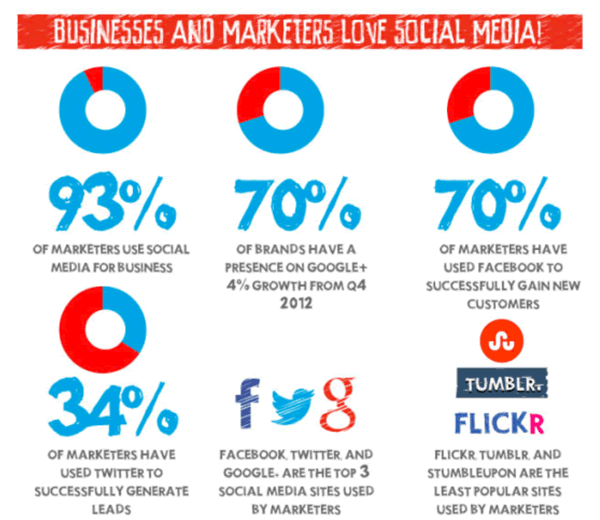
4. Leave your mark socially. If your business isn’t on any social networking websites, then, well, you're living under a rock. Facebook, Twitter, StumbleUpon, Digg, and many other sites are the key to reaching your target audience and engaging them in insightful ways. Additionally, while you may have a social media presence, you may not be using it to its full potential.
According to HubSpot’s Inbound Marketing Annual Report, social media produces almost double the marketing leads of trade shows and telemarketing. So, it’s time to dive into Twitter chats, build your presence on LinkedIn Groups, utilize Facebook advertising, and set up some Google+ Hangouts.
5. Embrace multimedia. Now more than ever is the time for meaningful imagery in your business's marketing tactics. YouTube receives more than one billion monthly visitors. The good news is, you don’t need to spend a fortune on cameras or lighting to spread your message through a visual medium. But you do need a strategy. Create a video campaign for your business. Be sure to use a keyword-rich headline, a strong editorial message, and a call to action.


Wednesday, 2 July 2014

Social Login Trends Across the Web for Q2 2014

Q2-Preferences

The ability to use an existing social network or email identity is now the most popular way to create accounts on the web. This shouldn’t come as a surprise; 90% of people have encountered social login before, and more than half of people use it. Social login streamlines the account creation and login process by eliminating the need to create and remember yet another username-password combination.

For the past four years, Janrain has published quarterly reports to shed light on consumer preferences for social login, with data aggregated from sites that use Janrain. The key takeaway, above all else, is that people want a choice of social login providers. The social media landscape is fragmented, and people use each of their  social networks for distinct purposes, whether to interact with friends and family, project professional identity or follow influencers.  We hope these findings provide a useful benchmark for developing your own personalized marketing strategy.

Social-Login-Trends

Facebook reversed a streak in which it lost market share in six straight quarters, increasing its share of social logins by 1.5%. The increase was especially pronounced on media, retail and B2B websites, each of which saw a 2% increase in Facebook’s share.

Google remains Facebook’s strongest contender. Its popularity may be the result of its push to unify each of its services, such as Gmail, Google+, YouTube, Android and Play, under a single Google identity. People are using a single Google identity to access each of these services, making it stickier.  Social login preferences tend to reflect consumer affinities, so we believe that the Google identity now has more brand affinity and value for consumers.

Facebook’s growth primarily came at the expense of Yahoo, which saw its share drop by 3%. For the first time since Q3 2012, Twitter surpassed Yahoo as the third most popular choice.  Just last quarter, Yahoo recorded its largest single quarter increase in four years on the heels of revenue gains and new identified revenue streams. It will be interesting to see if Yahoo can recover its Q1 momentum.

Despite the perception of a two-horse race, consumer preference differs widely across the world. In Russia, VK is one of the most popular social networks and is a common choice for social login. In China, networks such as Sina Weibo, Renren, Tencent Weibo and QQ are popular. In Japan, many choose Mixi.
We also observed that social login usage will vary when alternatives are present. Some of the identity providers we have recently started to support, such as Instagram and Amazon, earn anywhere from 10-25% share of social logins on sites that have enabled it. As more of our clients support these networks, we expect to see their market share climb.
As with our previous reports, we have taken a look at sites in six industry verticals to measure trends in consumer login preferences.

Media-Trends

Consumer-Trends 

Retail-Trends

Entertainment-Trends

Music-Trends 

B2B-Trends

Facebook overtook Google and LinkedIn as the most popular choice on B2B sites, with Facebook extending its lead on media and retail sites. We also observed a decrease in popularity for Google on retail sites. We expect this landscape to evolve as momentum builds for innovations such as Google Wallet Instant Buy and Autofill with Facebook, both of which encourage the use of social login during checkout.

What do these findings mean for your business? As you think of ways to improve registration conversion and know your customers, social login can play a major role:

For Marketers:

Social login helps solve the challenge of collecting accurate customer profile data without sacrificing acquisition rates. Social login accelerates the registration process to a single click and grants instant permission-based access to rich demographic and psychographic data about your customers. This social profile data can be utilized to improve segmentation, personalization and targeting efforts.

For Developers and Technologists:

It can be a headache to implement the plumbing for each social network API on your own.  Under the hood, these networks use different protocols like OpenID, OpenID Connect, OAuth, and proprietary frameworks. As a result, coding social login on your own requires significant investment of time and engineering expertise.  Ongoing maintenance is another challenge, especially when networks change their APIs, in some instances without advance notice.


Your social login and sharing solution should allow you to easily integrate multiple social networks by writing once to a single API. Implementing  social login technology on your site cuts deployment times to days from weeks or months and keeps engineering resources focused on your core competencies.


Thursday, 26 June 2014

Social media marketing for small businesses – a how to guide for beginners


10 steps for social media success

Social media marketing is a great tool for small businesses and one that you just cannot ignore. The number of people engaging in social media networks every single minute is so big and if your business is not participating in this mega digital party, you are missing out opportunities.

Obviously the next question is how can business owners take advantage of social media and whether it is something that can generate business results (i.e. more traffic, sales, leads, signups) or if it is just another myth?

#1 – Let’s get started

The first step is to actually move from theory to practice and get started with social media. This means 4 things:
  • To allocate some time on a daily basis to work on your social media presence
  • To choose which social media networks to use at the beginning since there are too many and it will be very difficult to do all at the same time.
  • To create your business pages on those networks
  • To SEO optimize your social media profiles for more exposure
Some things to consider:

Facebook – Everybody is on Facebook so you don’t actually have a choice here. Read this to get inspired: How to get your first 10,000 fans on Facebook. Note: Since that article was written, the page has now more than 45,000 fans.

Google+Google plus is for businesses and it’s also owned by Google so this is your second choice.

Pinterest – It’s growing rapidly and can send a lot of traffic to a website so this is your next choice provided that you have something visual related to your business that you can share on Pinterest.

Twitter – millions of users, easy to maintain and good way to engage with your customers. Together with the previous 3, this is your priority list.

LinkedIn – Mainly for business professionals, more difficult to use, advertising is expensive. You can create your presence on LinkedIn but if you are short of time, I suggest you start using LinkedIn for your personal profile and then when you grow your business profiles on the other networks, you can utilize LinkedIn for your business as well.

#2 – Start Small

When you are ready to get started do not rush into following hundreds of people, posting many times per day and checking your statistics every minute. Start small and have in mind that:
  • Social Networks do not like too much activity on newly created accounts (it’s not normal and kind of spammy)
  • All networks have a maximum number of actions (following and unfollowing) you can do per day so the best way is to stay below their radar.
  • At the beginning and when you don’t have a good number of followers, nobody will see your posts so don’t spend your time for no reason.

#3 – It’s a numbers game

While there are millions of people in social media channels, in order to start getting traffic, making sales or have any influence at all, you need to have a LOT of followers in your networks. And by a LOT, I mean a LOT and let me explain why.

When you publish a new post on your business page on Facebook that post will be seen by a small percentage of your followers (FB tells you how many people saw your posts so have a closer look to understand what I mean).

Let’s say that you have 400 fans on your page, when you post something only 30-40 people will see it and this is because FB does not show the posts to all your fans.

The other networks may show your posts to all your followers but if a person is following a lot of other people/pages, there are limited chances that they will see and interact with your posts.

So, the more followers you have, the greater are your chances of start getting anything out of social media. From my experience and without this being a definite guide, you need at least 10,000 on FB, 1000 on G+, 1000 on Twitter and 2000 on Pinterest before seeing any visitors to your website or shop. Of course as I said this is not a rule but an empirical figure.

#4 –Follow people that matter

Unless you are a known brand, in order to grow your followers you need to follow other people and some of them will follow you back. When choosing who to follow be selective by applying these simple techniques:
  • Follow people that have a relation with your business either geographically (i.e. they live in the same area) or by interest (they are interested directly or indirectly in the products or services you are selling).
  • Follow people who have an active profile; there is no reason to follow someone on twitter if they haven’t posted anything for two months.
  • Follow people that have a balance between the people they follow and people following them – you don’t want to follow people that will not follow you back and also you don’t want to follow accounts that only have following and no followers
  • Follow people that have something interesting to say – before following someone have a look at what they share and decide if this is something your customers would like to see in your profile.
  • Find and follow the influencers in your niche – every business area and niche has influencers and although they will not follow you back, it’s always a good practice to connect with them and follow what they have to say about the industry.

#5 – It’s time consuming – make sure you have the time

Social media marketing is relatively easy to do but it is a very time consuming task. Before starting make sure that you have the time to do this consistently and on a daily basis. I would say that a couple of hours per day is enough to get you started.

If this sounds a lot then you can either consider to outsource social media to professionals or start with fewer networks (for example Facebook only) and then when you find time jump in to the rest.

Have in mind though that if you don’t spend the necessary time working your business pages, you will be disappointed by the results and start believing that social media does not work for business (an assumption that is totally wrong).

#6 – Make your posts interesting

As I mentioned before, search engines and social media networks can only understand one thing, and this is content. This means that besides working on getting new followers, you also need content.

If you already have a content marketing strategy then your work on social media will be easier but if you don’t, then you need to come up with a plan along these lines:
  • Post about your products and services but don’t overdo it – Your business page is about your business but if you keep posting about how nice your products are, you will keep people away.
  • Instead you should make your posts interesting by providing tips, advice, offers and anything else that can make someone share or comment in your posts.
  • Don’t forget that in order to get any likes, +1s or comments you need to have a LOT of followers. Don’t expect this to happen in the first few months or when your numbers are still low.
Have a look at one of social media pages we manage for one of our clients. Look at the variety of postings, frequency, tone, format etc.

#7 – Timing does matter

The time and date you post something in social media matters a lot. As mentioned above, people have a lot of posts in their timelines and if they don’t see it ‘live’ then most probably they will never see it.

For example, if you post something on twitter and your followers are sleeping at that time, by the time they will wake up they will have hundreds of messages in their timeline and so there is no chance of seeing your post.

To solve this problem, you can use tools like bufferapp to schedule your postings so that you reach your target audience at a time where you have more followers online. There are also other tools and statistics about the best time to post on the different social networks but as a rule of thumb, post either in the morning (08:00 – 9:00) or afternoon (17:00 – 19:00). These are the times that work best for many niches.

#8 – Follow up comments and mentions about your business

Social media is about communication and this means that you need to monitor your social media pages for comments about your business and definitely respond to both good and bad comments. You need to show your audience that you are reading what they have to say and care about their opinion.

Besides monitoring your business pages, you should also monitor the mentions about your brand name in across all social networks and take action where appropriate. A nice tool to do that is mention (it’s not free).

#9 – Measure the results and ROI

If you don’t measure the effectiveness of social media then you won’t know if it worth’s your time or not. What to measure?
  • Number of visits from social media to your website
  • Number of conversions (sales, newsletter signups, etc)
  • Monthly increase of followers
  • Monthly increase of interactions
How to measure?

Using Google Analytics reports and statistics provided for business pages by the various social networks.

Note: If you still at the beginning then most probably those numbers will be low or close to zero but don’t get disappointed, once you grow your followers you will notice that these numbers will start to increase as well.

#10 – If everything fails, leave it to the pros


Social media works for businesses and this is a fact. It is also true that every problem has a solution so if you don’t have the time or knowledge to make social media work for your business then leave it to the pros; we have different social media packages for each budget and need and we guarantee minimum results.


Click here to full view version of this topic

Thursday, 19 June 2014

60 Marketing Acronyms Every Industry Pro Should Know


Have you ever heard an acronym but you didn't know what it meant? It can really throw you off your game in a conversation. I usually try to write it down discreetly or, if I have a laptop, look it up online without anyone seeing. But some acronyms have multiple meanings, even industry-specific ones, and sometimes Wikipedia doesn't do them justice.


That's why we curated 60 of the most common marketing acronyms into an epic glossary you can skim, study, or bookmark and save for later. The more you know, the more likely you'll be able to understand and participate in conversations going on around you.

60 Common Marketing Acronyms

AIDA: Attention, Interest, Desire, Action

The four steps of the now somewhat outdated Purchase Funnel, wherein customers travel from consideration to purchase. Learn more about the new purchase consideration cycle.


aida-sales-funnel


ASP: Application Service Provider

Internet hosting that provides computer-based services to customers over a network. (See SaaS.)

API: Application Programming Interface

A computer programming term meaning a series of rules. APIs allow an application to extract information from a service and use that information in their own application, or sometimes for data analysis. It's kind of like a phone for applications to have conversations -- an API literally "calls" one application and gets information to bring to you to use in your software. APIs facilitate the data needed to provide solutions to customer problems...


More information for this post related Visit here website link